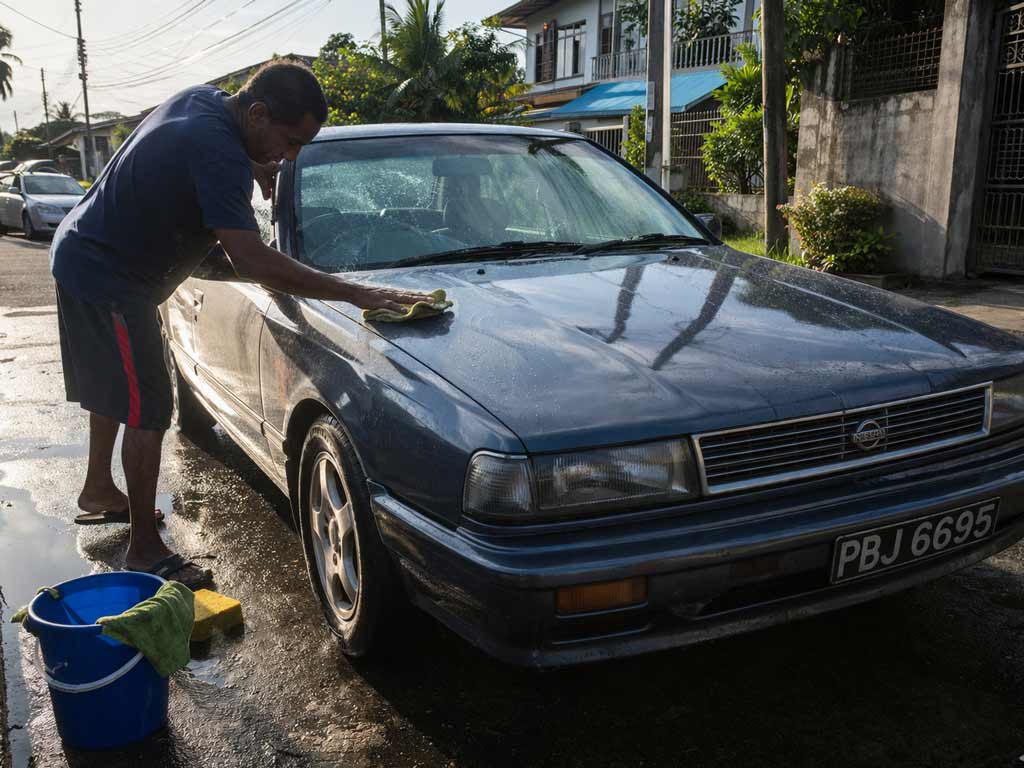
There was a particular kind of quiet that settled over a street just after sunrise on a Sunday. Not silence, never that, but a softer rhythm. A bucket scraping lightly against concrete. The slap of wet cloth against metal. A radio playing somewhere inside a house, low enough that you caught only fragments of melody between the sounds of water.
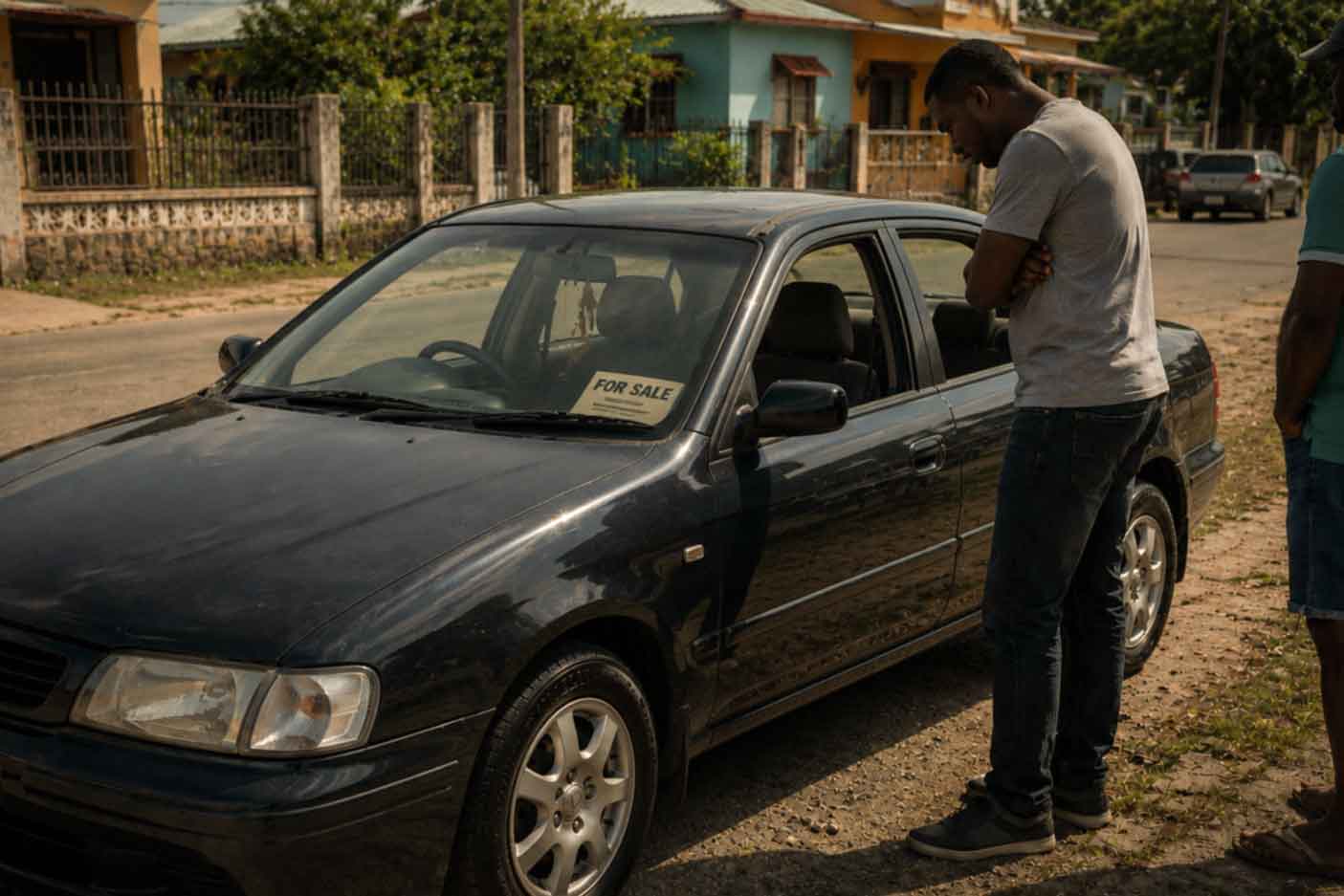
Cars were already outside by then. Parked at angles that made no sense except to the person washing them. Doors open. Bonnet lifted, sometimes unnecessarily. A man, or sometimes a boy drafted into the role, leaning into the work with a seriousness that felt out of proportion to the task. It wasn’t just a wash.
It was a showing.
The smell carried first. Not soap exactly. Something sharper. Sweet in a way that stuck in your throat. If you knew it, you could identify it from half a block away, wax, the kind that came in a dented tin, rubbed on in slow circles until your arm burned a little. People still say “Turtle Wax” even when it isn’t. That scent had a way of attaching itself to memory, like petrol or cut grass.
There was a sequence to it, though nobody ever wrote it down. Rinse. Soap. Rinse again. Then the slow part, the part that mattered. Waxing wasn’t about cleaning. It was about time. About how long you were willing to stay with the machine after the obvious work was done.
You saw it in the way people leaned back to look at their progress. Not once. Repeatedly. A glance, then a step closer to fix something only they could see, then another glance. That look wasn’t for anyone else, even though the whole thing was happening in public.
And it was public. That’s the thing people forget now.
You didn’t wash your car behind a gate. You did it on the edge of the road, where anyone passing could see. Neighbours walking by would slow, not quite stopping, but long enough to let their eyes travel over the car in that familiar way, checking the shine, the tires, the small details. Comments were rare, but not absent.
“Boy, you working today, eh.”
Not praise. Just acknowledgment.
Across the street, someone else was doing the same thing, slightly differently. Different cloth. Different method. Maybe a different standard altogether. You noticed. Everyone did. There was a quiet comparison happening, unspoken but present.
Machines had a different weight back then. Not physically, though some of them were heavy enough, but in how they sat in a person’s life. A car wasn’t just transport. It was evidence. That you were managing. That you were taking care of something that required ongoing attention. Ownership wasn’t passive. It asked things of you.
You could tell who drove a car by how it looked on a Sunday morning.
Some went hard on the details. Tire shine applied with care, not sloppily sprayed. Rims wiped until the metal held light in a certain way. Others stopped once the dust was gone, satisfied with clean but not polished. Even that said something.
Kids were part of it whether they wanted to be or not. Handed a rag, told to “start with the doors.” They learned quickly that water alone wasn’t enough. That there was a right pressure, a right motion. Too rough and you got corrected. Too careless and you had to do it again.
There was always a moment when the work shifted. When it stopped being about instruction and became about habit. You could see it happen without anyone announcing it. A boy rinsing off suds starts paying attention to reflections instead. Noticing streaks. Fixing them without being told.
That’s how the ritual moved forward. Not taught formally, but absorbed.
By mid-morning, the street looked different. Cars that had been dull now held the sky on their surfaces. Clouds stretched across bonnets. Sunlight sharpened edges that had been soft an hour before. It wasn’t perfection, never that, but it was deliberate.
You saw people step back then. Hands on hips sometimes. Or wiping their hands on an already-damp cloth, looking not at the whole car but at one section. The hood. The side panel. The place where light hit just right.
That glance back again.
Nobody called it satisfaction. That would have been too neat a word for something that was half pride, half relief. The work was done, but more than that, the car had been returned to a state that felt correct.
It’s easy to frame all of this as nostalgia. To say people had more time then, or fewer options. That misses it.
What changed wasn’t just the availability of automated washes. It was the relationship between person and machine.
Drive into a modern car wash now and you stay inside. Engine idling. Hands off everything. Water hits the glass in controlled patterns. Brushes move with mechanical certainty. Foam appears, disappears. Two, three minutes, and you’re out the other side.
Clean.
Efficient.
Forgettable.
There’s no smell that stays with you. No residue on your hands. No need to look back at anything because you never left your seat. The machine has taken over the entire exchange. You bring the car in dirty and leave with it clean, with nothing in between that belongs to you.
It’s not wrong. It’s just different in a way that removes something harder to name.
That Sunday ritual was never only about maintenance. It was a kind of performance, yes, but not in the sense of showing off. More like demonstrating a relationship. Between a person and an object that required attention to remain what it was.
There’s a tension in that kind of care. Literal resistance, cloth against paint, wax against metal, and something else underneath. A resistance that asks you to slow down, to stay with the task longer than necessary.
Convenience has no use for that.
And so the small things disappear first. The dented bucket that never quite emptied. The specific cloth kept aside just for drying. The way someone would test the surface with the back of their fingers, not the palm. Habits that don’t translate when the process is compressed into minutes and handled elsewhere.
You still see remnants if you look carefully.
A car parked outside, someone wiping down just the windshield. Another person focusing only on rims, ignoring the rest. Fragments of a larger routine that no longer holds together.
Older cars seem to attract it more. Maybe because they show their age more honestly. A newer vehicle can carry neglect without immediately revealing it. The older ones demand attention, or at least they used to.
There’s also something about the pace of Sunday itself. It used to hold space for this kind of work. Not scheduled, not optimized. Just expected. You knew that at some point between morning and midday, the car would come out and the process would begin.
Now Sunday has a different texture. Quieter in some ways, busier in others. The ritual doesn’t fit as easily. Or maybe it doesn’t feel necessary anymore.
That might be the real shift.
Not that people stopped caring, but that the expression of care changed. It moved inward, became less visible, less shared. Maintenance became private, outsourced, or reduced to occasional attention instead of something repeated, almost ceremonial.
Machines improved. They always do. They ask less from us over time.
But there’s a cost to that easing. Not dramatic. Not something you notice immediately. Just a gradual thinning of the moments where effort and attention meet something tangible.
The old Sunday wash sat right in that intersection.
You felt it in your hands. You saw it in the reflection that sharpened slowly, not all at once. You carried the smell of it inside with you afterward, even after you washed your hands.
And later, when you passed the car again, heading out, or just moving through the yard, you couldn’t help it.
You glanced back. Not to check if it was clean.
Just to see it.