The boy raises his hand before I finish the sentence. Not because he has a question about the work. He has not heard the work yet. His hand is up because he is already calculating how long this will take.
“Sir, how long this go take?”
I look at him. He looks at the door.
I say, “About twenty minutes.”
He exhales like I just told him to run a mile. His shoulders drop. He slumps into the desk. Beside him, another student has already opened a second tab on the laptop. A third is reaching for a phone tucked under a notebook. Nobody has written anything yet. I have not finished giving the instruction.
This is not a bad class. They are not disrespectful. They are just unused to being asked to stay in one place for longer than a thing takes to load.
I write the problem on the board. A simple quadratic equation. Something that requires four steps if you do it slowly, three if you know the shortcut. I tell them to try it on their own first. No talking. Just the page and the pencil.
The room settles into something that is almost quiet. But it is a restless quiet. Pens tap. Knees bounce. Someone sharpens a pencil that was already sharp. Two students stare at the ceiling. One puts her head down on her folded arms.
After ninety seconds, the first one stops.
“I done.”
I look at his page. He has written the answer but none of the steps. The answer is wrong.
“Show me how you got there.”
He shrugs. “I just see it.”
He does not mean he calculated it. He means he guessed. Or he used an app. Or he looked at the problem and expected the solution to appear the way a video appears when you tap the screen.
I ask him to try again. This time, write each step.
He stares at the page for five seconds. Then his hand goes up again.
“Sir, this taking too long.”
It is the second minute of a twenty minute exercise.
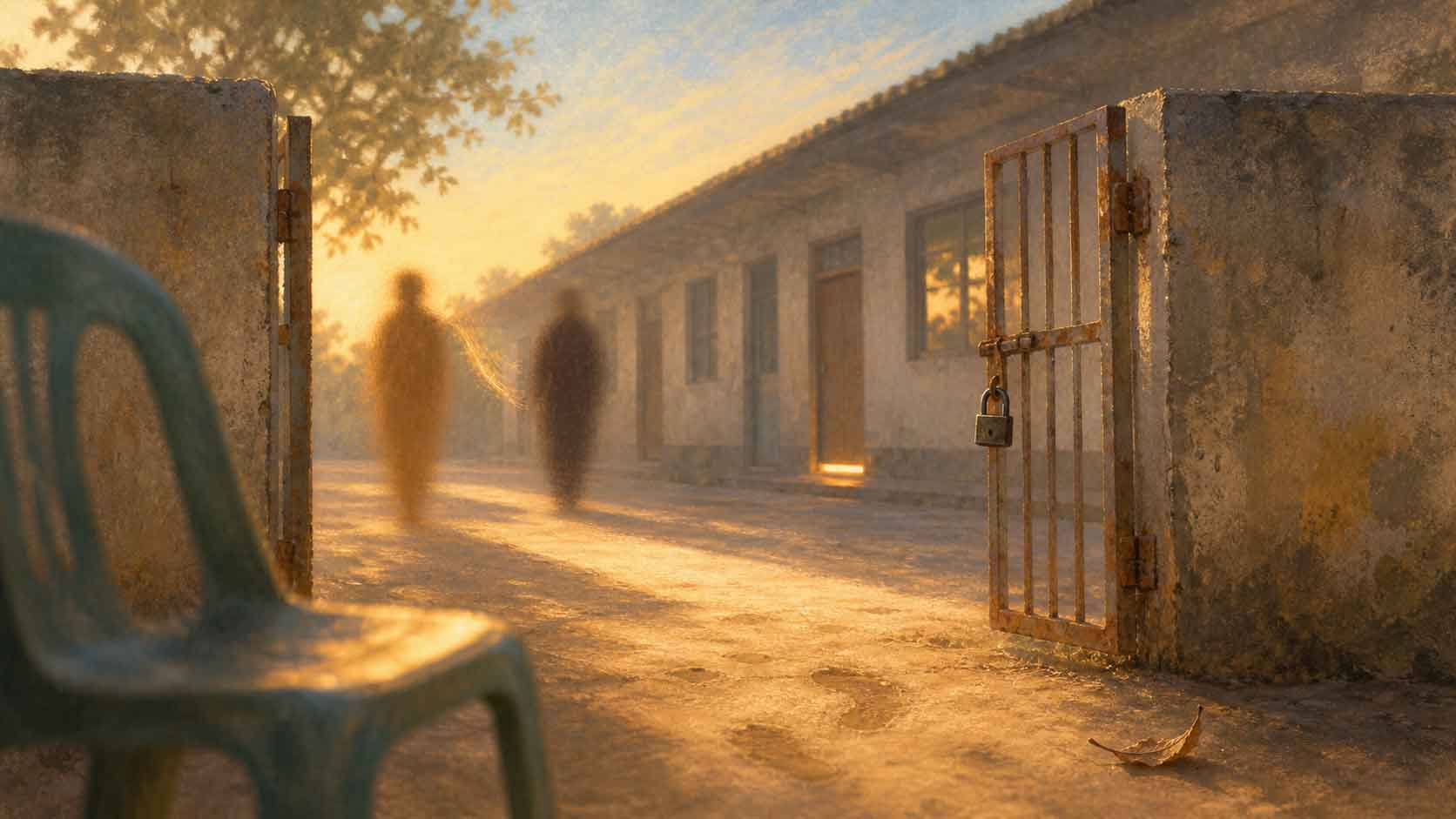
Later, during the break, I sit in the staff room and think about waiting. Not in a grand way. Just in a small, physical way.
When I was his age, waiting was not something you noticed. It was just the shape of things.
I remember standing in City Gate, waiting for a maxi to fill. Not two minutes. Not five. Sometimes twenty. The driver would sit there, elbow out the window, not rushing. Nobody asked how long. You just stood. You shifted your weight from one foot to the other. You watched a dog cross the road. You listened to a woman argue with a vendor about the price of chive. You learned the names of trees you had passed a hundred times without seeing.
I remember the coal pot in my grandmother's yard. Water took a long time to boil on that thing. Not because it was slow. Because it was honest. You lit the charcoal. You waited for it to catch. You fanned it sometimes. You looked at the sky, at the laundry on the line, at a lizard on the wall. The water boiled when it boiled. There was no rushing it.
I remember the television station signing off at midnight. The national anthem. Then a high pitched tone and a test pattern that stayed on screen until morning. You could wait for something to come back on. Or you could go to sleep. Either way, you could not make it come faster.
That world is gone. Not better or worse. Just gone.
Now, a student opens a laptop and the screen lights before the lid is fully up. A question appears in a search bar and answers arrive in less than a second. A message is sent and a reply is expected before the phone returns to the pocket.
The discomfort has been removed.
And discomfort, I am starting to think, was not the enemy. It was the thing that taught you how to stay.
Back in the classroom. The boy who complained about the time is now on his third attempt. He has written two steps. He is stuck on the third.
I watch him. He does not look at the board. He does not look at his neighbour. He looks at the corner of his desk. His jaw is tight. His pencil is still.
“Wha next?” he says. Not to me. To the air.
I do not answer right away. I wait three seconds. Four.
He picks up the pencil. Draws a line under what he has written. Then stops again.
This is what I am seeing more and more. Not an inability to solve problems. An inability to stand inside the discomfort of not knowing. The moment the answer does not appear, something closes. The shoulders go up. The eyes go flat. The hand reaches for a phone that is not there.
I have seen the same thing happen in a fight outside the caferteria shop. Two boys. Something small started it. A word. A look. But the real fuel was not the insult. It was the speed of the reaction. No pause. No breath. No one saying, “Wait, let me think.”
The punch came before the thought.
The same way the answer came before the steps.
When the bell rings, the boy hands me his book. He has finished the equation. The steps are there, mostly. The answer is correct. But he does not look satisfied. He looks tired.
“That take real long,” he says.
“It took fifteen minutes,” I say.
He nods. He is already packing his bag. The next class is waiting. The next screen. The next thing that will answer before he asks.
I keep his book open on my desk for a minute after he leaves. The steps are uneven. The handwriting changes halfway through, getting smaller, then larger again. A line is crossed out. Another is underlined twice.
It looks like someone who stayed.
I close the book and put it on the pile. Outside, the corridor is loud with students moving between rooms. Nobody is walking slowly. Nobody is standing at a window looking at nothing.
The bell for the next period rings. I pick up my marker. A voice from the doorway: “Sir, what we doing today?”
I tell them.
Already, someone is checking their watch.