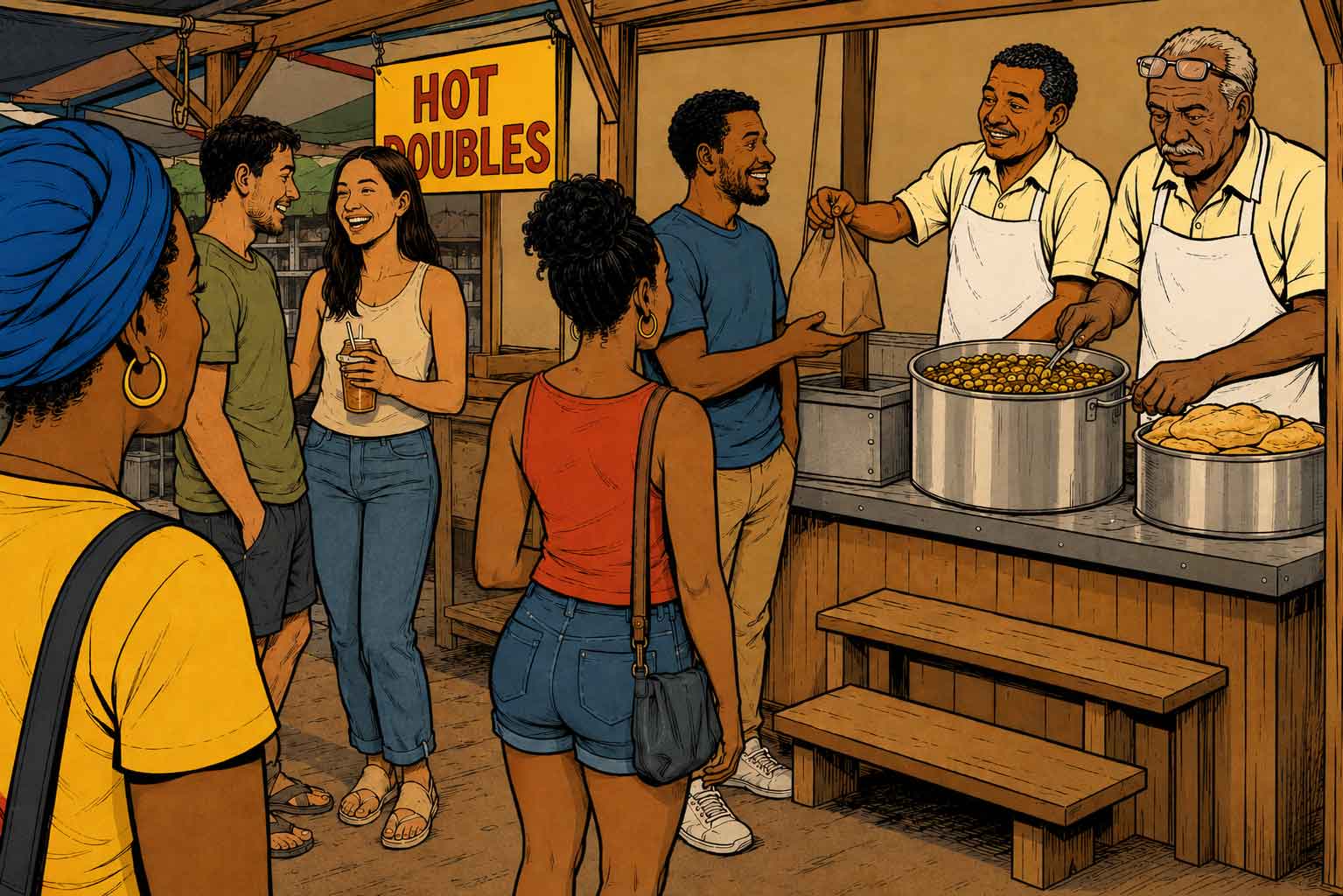
The man in front of me doesn’t order.
He steps up, nods once, and leans slightly on the counter. The vendor is already moving. Two bara open, channa spooned, a quick glance up.
“Pepper?”
A small pause. A half shrug.
“Same.”
The paper folds. Money changes hands without counting. The whole thing takes less than a minute, but nothing about it feels rushed.
This is not efficiency. It is recognition.
There is a difference between food that sees you and food that processes you. Roadside vendors, at their best, operate from recognition. Branded chains operate from protocol. Both feed people. Only one pays attention.
That distinction is easy to miss because the surface comparison is usually framed in simpler terms. Clean versus messy. Reliable versus risky. Air conditioning versus heat. The real difference sits in how decisions are made in the moment.
At a chain, the decision has already been made. The menu is fixed, the portions fixed, the sequence fixed. The person behind the counter is not expected to notice you beyond what is necessary to complete the order. That is the design.
At a roadside stall, the design is the person.
A man asks for a box lunch. The vendor opens the pot, looks at what is left, and adjusts without announcing it. A little more rice. Less gravy than usual. A piece of chicken that is not the standard cut, but better than the one before it. The customer does not argue. He watches, then nods. Something has been negotiated without words.
This is not inconsistency. It is judgment.
There is a tendency to describe roadside food as unpredictable, as if that is a flaw. It is more accurate to say it is responsive. The food changes because the conditions change. Ingredients run low. The crowd shifts. The weather presses in. The vendor adapts, not to maintain a fixed standard, but to preserve a relationship.
A chain cannot do that. It is not built to.
Inside a branded space, everything is designed to remove interpretation. The person at the register does not decide how much sauce you get. The grill operator does not decide when something is done based on how it looks or smells. There is a timer for that. A chart for that. A right way and a wrong way, both documented.
That machinery works. It produces consistency at scale. It allows a meal in one location to resemble a meal somewhere else. It reduces error by reducing choice.
It also removes the possibility of being known.
You can visit the same chain ten times and remain a stranger. Not disliked. Not mistreated. Just unseen. Your preferences exist only if you state them, and even then they are processed, not remembered. The franchise does not carry you forward.
At a roadside stall, repetition accumulates.
You come once and you are a customer. You come three times and you are someone the vendor has seen before. You come ten times and something shifts. The questions get shorter. The adjustments get faster. At some point, you stop explaining yourself.
The vendor begins to anticipate you.
That anticipation is not perfect. It is not meant to be. Sometimes they get it slightly wrong. Too much pepper. Not enough sauce. A different piece than you expected. But even that carries a kind of logic. You can see the decision being made. You can disagree with it, but you cannot say it was mechanical.
There is a small detail that stays with me. A plastic bag hanging from a nail at the side of a stall, already packed before the customer arrives. No name written on it. No receipt attached. Just a quiet assumption that the person will come, and that this is what they will want.
That kind of preparation does not exist in an environment built on anonymity.
It is easy to argue that this approach is inefficient. That it depends too much on memory, on mood, on individual skill. That it cannot scale. All of that is true.
It is also beside the point.
Efficiency is not the only value at stake when people eat.
The roadside environment introduces friction. You might wait longer than expected. You might have to repeat yourself over the noise. You might stand instead of sit. None of this is optimized. Yet people return, not out of habit alone, but because something in the exchange feels intact.
The vendor is not interchangeable. That matters.
At a chain, the face across the counter can be replaced without altering the experience. That is the goal. The brand remains steady. The individual disappears.
On the roadside, the individual is the experience. The food is tied to a specific pair of hands, a specific rhythm, a specific way of doing things. If that person is absent, the stall is not the same, even if the recipe is.
That difference carries a kind of risk. It also carries a kind of value that is harder to measure.
There is a moment that happens often enough to notice. A customer hesitates while ordering, unsure of what they want. At a chain, this slows the line. The expectation is that you decide quickly, select from the board, move on.
At a roadside stall, hesitation invites a response.
“Take the stew today. It come out good.”
That sentence does more than guide a choice. It asserts confidence. It extends a small form of care. It suggests that the vendor is not just executing orders, but standing behind what they are serving right now.
You can accept or reject it. Either way, you have been addressed as someone capable of being guided.
That does not happen in a setting designed to eliminate variance.
The Shadow Side of Being Seen
But there is another layer worth naming. Being known is not always a gift.
The same vendor who remembers you might also resent you. A regular who asks for a small adjustment every day can become a quiet burden. I have watched a man nod at a customer and then, as soon as the customer turned away, roll his eyes and mutter. The recognition was there. It just was not warm.
Favoritism also creeps in. The vendor who knows your name might give you an extra piece while someone new waits longer for worse service. That is not fairness. That is the messy, human cost of a system built on personal relationship.
And there is the pressure of being known when you just want to be anonymous. Some days you do not want to explain that your usual is not what you feel like today. Some days you want to walk into a place where no one expects anything from you. A chain can offer that, a kind of merciful blankness.
The roadside stall cannot. Once you are seen, you stay seen. That is part of its honesty and part of its weight.
So neither model is pure. One may process you, but it also leaves you alone. The other may see you, but it also holds you.
A Third Mode: The Absence of Both
What about delivery apps?
Here, the food arrives, but the person who made it is entirely absent. There is no exchange at all. The algorithm matches your hunger to a kitchen, and a stranger on a scooter becomes the only human trace. You cannot be processed because there is no counter. You cannot be seen because there is no one to do the seeing.
Delivery is efficient in a different way. It removes friction entirely. It also removes the possibility of relationship. The food fills you, but it does not place you in relation to anyone.
That is not nothing. Sometimes that is exactly what you want. But it is worth noticing what is lost when even the chain’s minimal interaction disappears.
Where That Leaves Us
None of this makes roadside food inherently better. There are stalls that are careless, inconsistent in ways that do not serve anyone. There are chains that are clean, efficient, and dependable when that is exactly what you need. The point is not to romanticize one or dismiss the other.
The point is to recognize what each one does.
One is built, sometimes unintentionally, to process you. To move you through a structure that has already decided what matters. Speed. Uniformity. Predictability.
The other is built, sometimes unintentionally, to see you. To adjust, to remember, to respond in ways that accumulate over time.
Delivery apps, meanwhile, are built to erase the interaction entirely.
These differences are not always visible in the food itself. They show up in the space around it.
You feel them when you do not have to explain yourself.
You feel them when someone adjusts the plate before you ask.
You feel them when the exchange carries a trace of memory, even if you cannot point to where it began.
It is a subtle distinction, but it shapes the experience more than most people acknowledge.
Food does not only fill you. It also places you, briefly, in relation to someone else.
Not every arrangement of the world is designed to do that.
The ones that are, you remember.