The first sound was never the music.
It was the click.
A deliberate, mechanical decision. The kind that travelled through your fingertip into the body of the machine. Play. Record. Sometimes both pressed down together with a little extra force, just to be sure. Then the faint whir, the soft turning of spools, and only after that, if you got it right, the song.
There was always a moment of doubt in between. A half second where you wondered if you missed the intro. Or worse, if the DJ was about to talk over it.
I still remember sitting too close to the radio, finger hovering, waiting for the exact opening bar. Not the fade-in version. Not halfway through. The real start. If you knew the song well enough, you could feel it coming. A drum count, a synth swell, a silence that meant something was about to begin. And then you pressed.
Too early and you caught static. Too late and you lived with it.
You didn’t get infinite retries. That was the point.
A cassette wasn’t just a storage device. It was a commitment. Sixty minutes, maybe ninety if you were feeling ambitious or reckless. That length wasn’t abstract. It had weight. It forced decisions. You had to think about how much space a song deserved, where it sat in relation to the next one, how Side A would feel compared to Side B.
You learned timing the way cooks learn heat.
I had tapes where the last song on Side A would fade out just as the tape clicked to a stop. Not by accident. That took planning. You’d sit with a notebook, scribbling durations, doing rough math in your head, trying to make everything land just right. If it didn’t, you either lived with the awkward cut or you re-recorded the whole side.
Most of the time, you lived with it.
There was something honest about that imperfection. A song clipped too early. A fragment of radio chatter left at the beginning. The faint ghost of whatever used to be on the tape bleeding through if you didn’t record over it properly.
Those flaws weren’t mistakes. They were fingerprints.
The cassette itself felt alive in a way nothing digital ever has. You could hold it up to the light and see the tape wound inside, tight or loose depending on how it had been handled. You could tell when it was getting tired. The sound would warp slightly, pitch bending just enough to make you uneasy. And then there were the moments when the player betrayed you completely.
The tape would get eaten.
It happened without warning. One second you’re listening, the next there’s a dragging sound, and the music slows like it’s sinking underwater. You eject the cassette and there it is, a ribbon of brown tape spilling out, twisted and exposed.
There was a whole ritual to saving it. A pencil, always a pencil, slipped into the spool to wind the tape back in carefully. Not too fast. Not too tight. You tried to smooth out the creases with your fingers, knowing it would never sound quite the same again.
And still, you kept using it.
Because tapes weren’t disposable. Not really. You reused them. You recorded over them. You traded them with friends, sometimes with no label at all, just a mystery waiting inside. You’d borrow one, copy it, pass it on. Music moved hand to hand, not through a network but through people.
There was a kind of trust in that.
You’d get a tape from someone and it wasn’t just songs. It was a sequence. A mood. An argument, sometimes. You could tell when someone cared about what they were making. The order mattered. The transitions mattered. Even the silence between tracks felt intentional.
The J-card told its own story.
Folded inside the plastic case, slightly worn at the edges, filled with handwriting that tried to be neat but rarely was. Song titles squeezed into tight spaces. Side A on one side, Side B on the other. Sometimes a little drawing, or a title for the whole thing if the person felt bold enough to name it.
You could recognize people by their handwriting alone.
Some tapes looked like they were made in a rush. Others felt almost formal, like they were meant to be kept. I’ve held tapes where the ink had faded but the intention was still there, preserved in the way the names were written, the way certain songs were underlined.
There was no “shuffle” button. No algorithm stepping in to smooth things out. If a song didn’t fit, it stayed awkward. If two tracks clashed, you felt it. And over time, that discomfort became part of the experience.
You learned what worked by listening, not by being told.
A lot of what we now call taste came from that process. Not from endless access, but from limitation. You didn’t have everything. You had what you could find. What played on the radio. What someone else was willing to lend you. What you could afford to buy if you saved long enough.
That scarcity sharpened things.
I think about how music moved through cars back then. A cassette deck built into the dash, the sun heating the plastic just enough to give it a faint smell. You’d slide a tape in and commit to it. No skipping tracks easily. You listened to what came next because that’s what was there.
And over time, you started to associate entire stretches of road with specific sequences of songs. Not individual tracks. Sequences.
There’s a particular curve in my mind that still belongs to a certain transition between two songs I recorded off the radio one afternoon. I couldn’t tell you the exact date. I could tell you exactly how it felt.
That’s what those tapes really held.
Not just music, but context. The room you were in when you recorded it. The static in the air before a storm. The voice of a DJ who talked too much but somehow became part of the track anyway. The frustration of missing the intro. The small victory of getting it perfect.
We built our own culture out of those moments.
The tools were simple. A radio. A cassette deck. A stack of blank tapes if you were lucky, or a handful of old ones you kept reusing if you weren’t. But the process demanded attention. You couldn’t be passive. You had to listen closely. You had to decide.
And once you made those decisions, they stayed.
There’s a photograph I took years ago of a cassette sitting on a car seat, late afternoon light catching the clear plastic just right. You can see the tape inside, slightly uneven, like it had been rewound too quickly. The J-card is half slid out, handwriting visible but not fully legible.
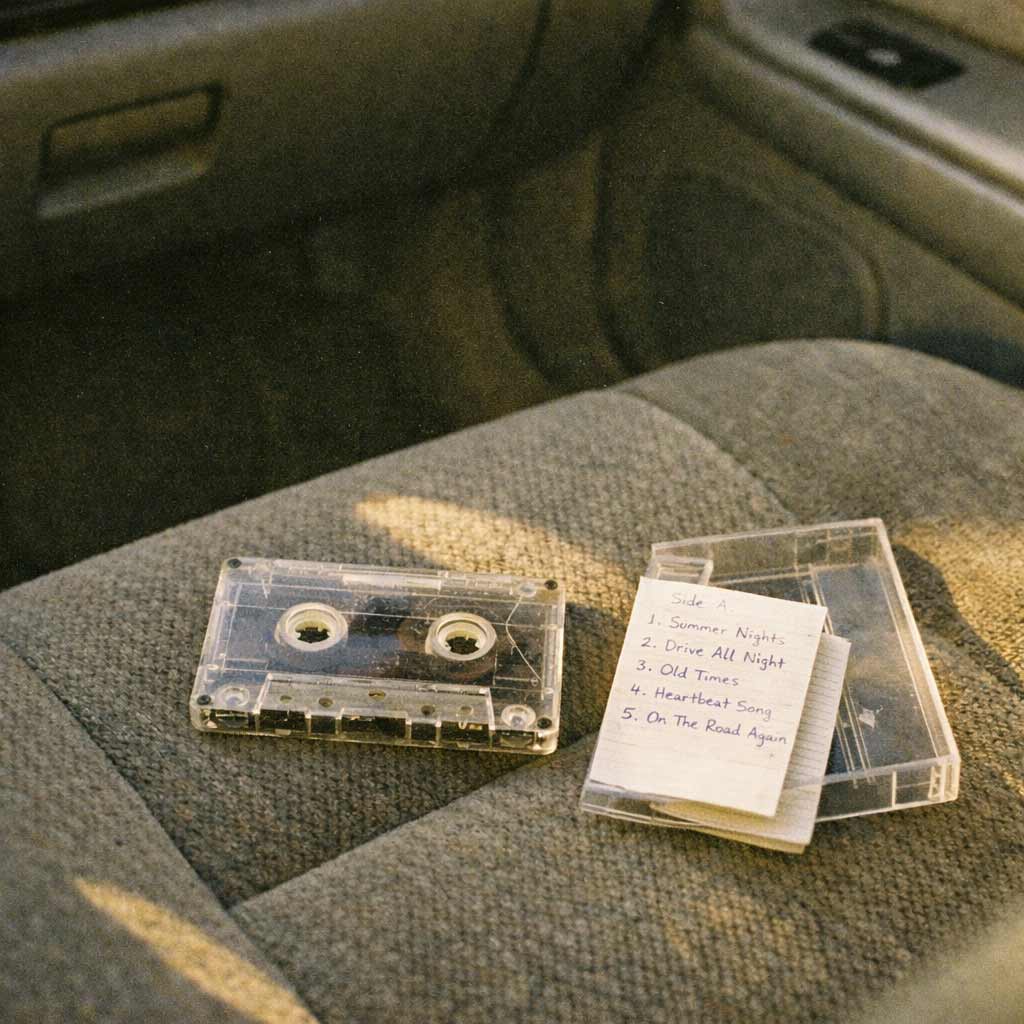
I didn’t stage it much. Just noticed it, the way you notice something that feels familiar without immediately knowing why.
That’s what the mixtape was.
Not perfect. Not permanent. But shaped by hands, by timing, by attention.
And always, before anything else, the click.