The lizard on the kitchen wall has been still for seven minutes. I know because I checked the clock above the sink when I first noticed him. His body is the colour of wet concrete. His toes spread against the painted surface like tiny umbrellas turned inside out. He is waiting for something I cannot see.
The kettle is cooling beside me. I came in here to make tea but the water boiled and I forgot to pour it. The steam rose and vanished into the louvered window above the stove. That window faces east. In the morning the light hits the aluminum and throws a pattern of thin stripes across the floor tiles. By now the light has moved. The stripes are gone.
I grew up believing a house was something you cleaned. You swept the yard on Saturday morning before the heat came. You wiped the windowsills because the dust from the road settled on everything by Wednesday. You poured bleach down the drains once a month so the smell would not rise up from the pipes. That was what it meant to take care of a home.
But the lizard does not care about bleach.
He shifts one front foot. A single toe lifts and presses down again an inch to the left. His throat pulses once. It is a small movement. If I were not standing here doing nothing I would have missed it.
The thing about watching a lizard is that you start to notice other things. The tiny black droppings on the windowsill that I used to wipe away without thinking. The mosquito carcass stuck to the wall near the light switch, too high to reach without a chair. The way the afternoon heat makes the wooden cabinet doors expand just enough that they stick when you pull them open.
My grandmother (God rest her soul) called the lizards "housekeepers." She said they ate the cockroaches you never saw and the mosquitoes you did. She never killed them. When one fell behind the refrigerator and could not get out, she slid a piece of cardboard underneath and carried it to the back door. She did not explain why. She just did it.
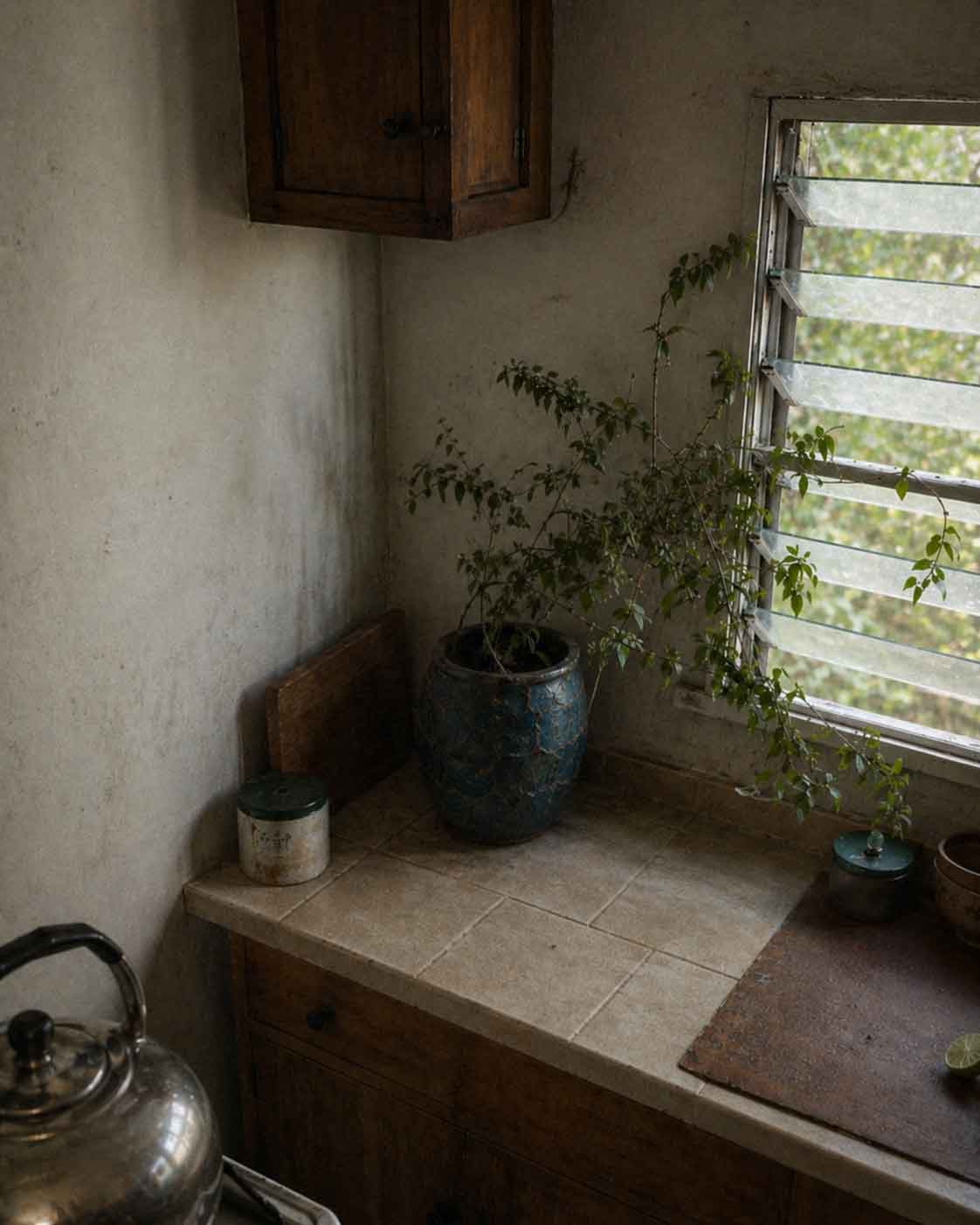
There is a plant on my kitchen counter that I bought two years ago because the woman at the nursery said it cleans the air. I do not remember its name. It sits in a blue ceramic pot with a crack along one side that I repaired with epoxy. The crack still shows. The plant has grown sideways toward the window. I have never rotated it. Every three or four days I pour a cup of water into the soil and watch it disappear.
That is not nurturing. That is barely remembering.
But the lizard is still here. So are the ants that found a crack near the back door last week. So is the spider that built a web in the corner above the dining table. I left the web because I wanted to see what it would become. It is now larger than my hand. The spider sits in the center during the day and moves to the edge at night. I have no idea where it goes.
I remember walking through my aunt's house in Arima when I was twelve. She had a small yard with a mango tree and a shed made of galvanise. The shed leaned to one side. She kept old tires in the corner because she said the frogs liked them after the rain. I thought she was being lazy. Now I think she was being something else. Not lazy. Just not in a hurry.
When the rain came hard that afternoon my cousin and I sat on the back step and watched the water run off the roof into a plastic barrel. The barrel had been cut in half lengthwise. My aunt had painted it green. The water filled it in maybe twenty minutes. Then it overflowed and ran down the slope toward the back fence where the bougainvillea grew. My aunt did not go outside to check the barrel. She already knew how much it could hold.
This is the part where I am supposed to tell you what I learned. Where I wrap it up and offer a system or a set of rules. Three steps to an ecosystem home. Five habits for nurturing your space.
But I do not have those.
What I have is a cooling kettle and a lizard that has not moved in seven minutes. What I have is a spider whose web I decided not to destroy. What I have is a memory of rainwater overflowing a painted barrel while I sat on a concrete step and said nothing.
The air in the kitchen smells like the lime I cut this morning. The peel is still on the counter near the sink. A small fly circles it. The fly will not last long. The lizard is still waiting.
I pour the cold water from the kettle into the plant. The soil accepts it. No sound. Just the darkening of the surface and the small shift of the leaves as if something underneath has stretched.
The lizard runs. Not because of me. I am still standing six feet away. Something else moved. A shadow. A vibration. Another insect. I did not see it. He did.
The wall where he was is empty now. The paint is off white. There is a small smudge at the spot where his toes pressed. I touch it with my finger. It feels like nothing. Fine dust. Old skin. The ghost of a grip.
I walk to the back door and open it. The air outside is heavier. The neighbour is burning something in his yard. The smoke drifts low and thin. I close the door halfway. Not all the way. Just enough to let the air move.
On the step outside, a small creature that is not a lizard freezes when it sees me. Its body goes rigid. Its throat pulses once. Then it runs into the crack beneath the door frame. I'm not sure if it was a lizard. It had no tail.
I do not know if I am nurturing my home. I know I left the spider. I know I did not kill the fly. I know the plant is still alive even though I forgot its name. I know the lizard will come back because they always do. They have more patience than I do.
The kettle is cold now. I put it back on the stove. I will boil it again later. Maybe I will make the tea then. Maybe I will stand here watching the wall instead.
The afternoon light has shifted again. The stripes are gone from the floor. But they will be back in the morning. They always are.