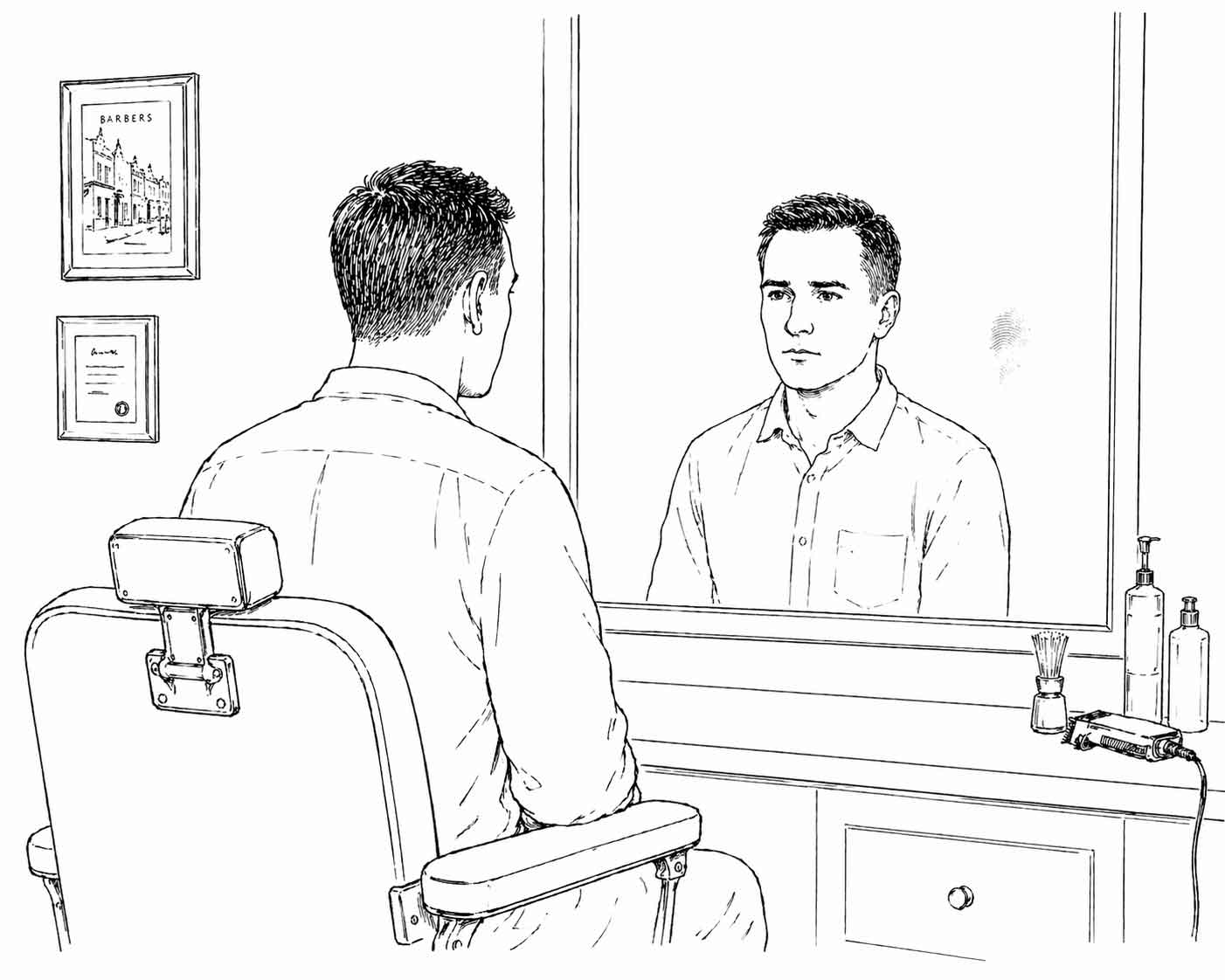
At the barbershop on a Saturday morning, a man studies his reflection a little longer than necessary. The chair has already turned back toward the mirror. The cut is finished. Still, he tilts his head, checks the line again, presses his palm lightly against the fade as if it might shift under his hand. No one is rushing him, but he does not get up.
This is not self care. It is inspection.
The language around grooming has softened over the years. Routines are framed as care, as restoration, as something owed to oneself. And sometimes that is true. There is a real difference between washing your face because it feels good and adjusting your appearance because you are anticipating judgment before it happens.
The problem is that both acts look the same from the outside.
A man buys a more expensive razor. A woman spends an extra ten minutes on her hair before leaving the house. A teenager restarts a video to check how their skin looks in the front camera. None of these actions carry their intention on the surface. They are quiet, ordinary, and easy to justify.
But intention matters more than the act itself.
Self care is inward facing. It is done with a kind of indifference to who might notice. It tends to be consistent, almost boring. The same soap, the same routine, repeated without much thought. There is no performance attached to it.
Social pressure is different. It is reactive. It changes depending on where you are going and who might be there. It sharpens before events and softens afterwards. It introduces a subtle tension into moments that should be neutral.
You can see it in small details. Someone wipes their shoes twice before stepping out, then glances at them again at the door. A person smooths their eyebrows in a dark car window. A phone screen becomes a mirror at a red light, held just below eye level.
These are not acts of care. They are acts of correction.
There is nothing wrong with wanting to look put together. The issue is not grooming itself. It is the quiet shift from choosing how to present yourself to feeling required to meet an invisible standard that keeps moving.
That standard rarely announces itself. It is picked up in fragments. A comment that lingers longer than it should. A photo that gets more attention than expected. A passing remark about looking tired. None of these are instructions, but they accumulate into something that feels like one.
Over time, grooming becomes less about maintenance and more about avoidance. Avoid looking unkempt. Avoid looking older than you feel. Avoid standing out for the wrong reason.
Avoidance is not care.
There is a version of self care that asks nothing from the outside world. It does not check for approval. It does not adjust itself mid day because someone might be looking more closely than usual. It is quiet enough that it can go unnoticed.
Most people recognize the difference when they are honest about it. The tension gives it away.
If you are thinking about how something will be received before you even step outside, that is not you taking care of yourself. That is you preparing for scrutiny.
And scrutiny has a way of expanding to fill whatever space you give it.