The toy chest used to make a particular sound when it opened.
Not a single sound, really. More like a spill. Plastic against plastic. A hollow, restless clatter that filled the room before anything even came out of it. I would lift the lid and the noise would arrive first, as if the toys had been waiting, pressed together, rehearsing their entrance.
My son would stand there, looking in, not reaching. His eyes moved quickly across the surface, skimming. A red wheel. A blue arm. Something with a blinking light already fading. He would pick one thing up, turn it over once, and drop it back into the pile where it disappeared immediately, swallowed by the others.
The lid stayed open. The noise settled into a quiet shifting.
Nothing held.
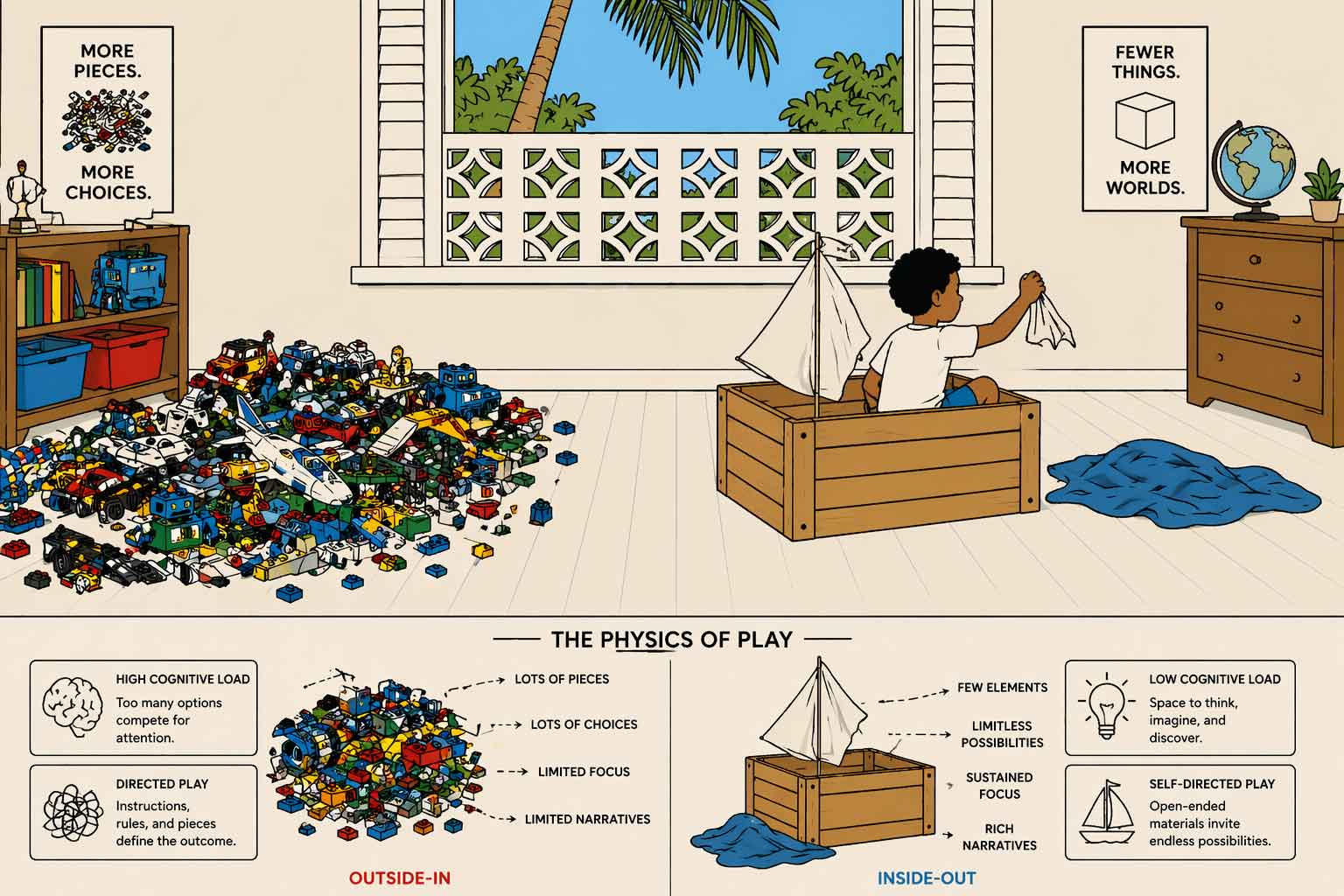
I started noticing it in small ways. The way he never carried anything far from the chest. The way the floor stayed mostly empty even though the room was full. A kind of hovering. As if the toys were not really objects but options, and the options kept interrupting each other.
One afternoon, I cleared it out.
Not completely. Just enough that the bottom of the chest showed through. A few wooden blocks. Two smooth stones we had picked up near the savannah. A length of string that had once been part of a package. Things that did not announce themselves.
When he opened it that day, the sound was different.
There was space in it. Air.
He reached in without pausing and pulled out the blocks. Two of them knocked together in his hand. A small, dry clack. He did it again, slower this time, listening. The room held the sound. It didn't scatter.
He sat down on the floor, not close to the chest, but a little distance away, as if the space mattered now.
The stones came next. He rolled them in his palm, then set them on the tile and nudged one into the other. Another clack. Softer. He leaned closer, almost over them, his shoulders rounding in. His breathing settled into something I could see.
There was no rush to replace one thing with another.
A few days later, someone brought over a gift. A large, glossy box with a picture of a robot on the front. It had panels and buttons printed in bright, certain colors. Words like advanced and interactive stamped across the sides.
We opened it together.
The robot lit up immediately. It made a sequence of sounds that seemed to explain itself. Instructions disguised as excitement. He pressed a button and it responded exactly as promised. Another button, another response. It did not wait for him to imagine anything. It arrived complete.
He watched it for a while, standing.
Then he walked away.
The cardboard box it came in stayed near the wall. Plain brown, one corner slightly crushed. I left it there without thinking much about it.
Later that afternoon, I found him inside it.
Not sitting, but kneeling, one hand holding the top flap half closed. He was speaking quietly, not to me. The string had been tied from one side of the box to the other, pulled taut. He plucked it once and listened. Adjusted it. Plucked again.
The stones were lined up near the opening like something that needed to be guarded or counted.
I stood in the doorway longer than I meant to. He did not look up.
Forty minutes passed that way. Maybe more. Time shifted into something less measurable. The robot was still on the floor where we had left it, its lights off now, its purpose paused.
There is a posture children have when they are not settled into anything.
I had seen it often enough before. The quick bending down, then standing again. The way the hands move without committing. Picking up, putting down. A kind of restless sampling. As if the body is searching for a place to land and not finding it.
I saw the opposite now.
Stillness, but not emptiness. A contained focus. His whole attention narrowed into that small square of floor and the space inside the box. The string, the stones, the edges of the cardboard. It was enough. More than enough.
It did not look like boredom.
Boredom, I realized, has a beginning that is uncomfortable to watch.
The first time I took most of the toys away, he stood in the middle of the room with nothing in his hands. He looked at me, then at the shelves, then back at the floor. There was a stretch of minutes where nothing happened. He shifted his weight from one foot to the other. Lay down. Sat up again. A small sigh, not dramatic, just there.
I almost interrupted it. Almost suggested something. Reached for a book, a leftover toy, anything to fill that space.
I didn't.
The room stayed quiet. No plastic noise to cover it.
Then, without announcement, he went to the corner and picked up the string. The same one. It had been lying there unnoticed before. He tied it between two chair legs and lay on his stomach, watching how it moved when he tapped it.
That was the moment it turned. Not suddenly, but clearly. The restlessness folded into something else. Not directed. Not instructed. Just… his.
I had spent a long time thinking I was supposed to provide the right kind of play. The better toy. The more thoughtful design. The one that would unlock something in him.
It is easy to believe that. The shelves in the stores make it look like imagination is something that can be packaged and improved, version by version. Each box a little more complete than the last. Less left to chance.
Standing in that room, watching him with a piece of string and a dented box, it felt quieter than that.
Not like something had been added.
More like something had been uncovered.
That evening, when he put the blocks back into the chest, they made that same small, contained sound. Wood meeting wood. A single, definite note. He closed the lid without rushing and walked away, leaving the room as it was.
For a while after, I stayed there, listening to what wasn't there anymore.